RAG Fails Silently: How We Engineered Quality Into Brand-Grounded Content Generation
Most software fails loudly. A crash, a stack trace, a 500 error — something tells you it's broken. RAG doesn't do that. A retrieval-augmented generation system that pulls the wrong pricing chunk, misses your compliance rules, or quietly blends last year's plan limits with this year's produces something worse than an error: a confident, fluent, wrong answer that looks exactly like a correct one.
When we built the Brand Knowledge system behind Visible's content generation — the RAG layer that grounds every AI-generated article and social post in a brand's approved facts, voice, and rules — we started from that premise. The interesting engineering problem wasn't retrieval. It was detection. Our job was to build the alarm systems our users can't.
What is Brand Knowledge RAG
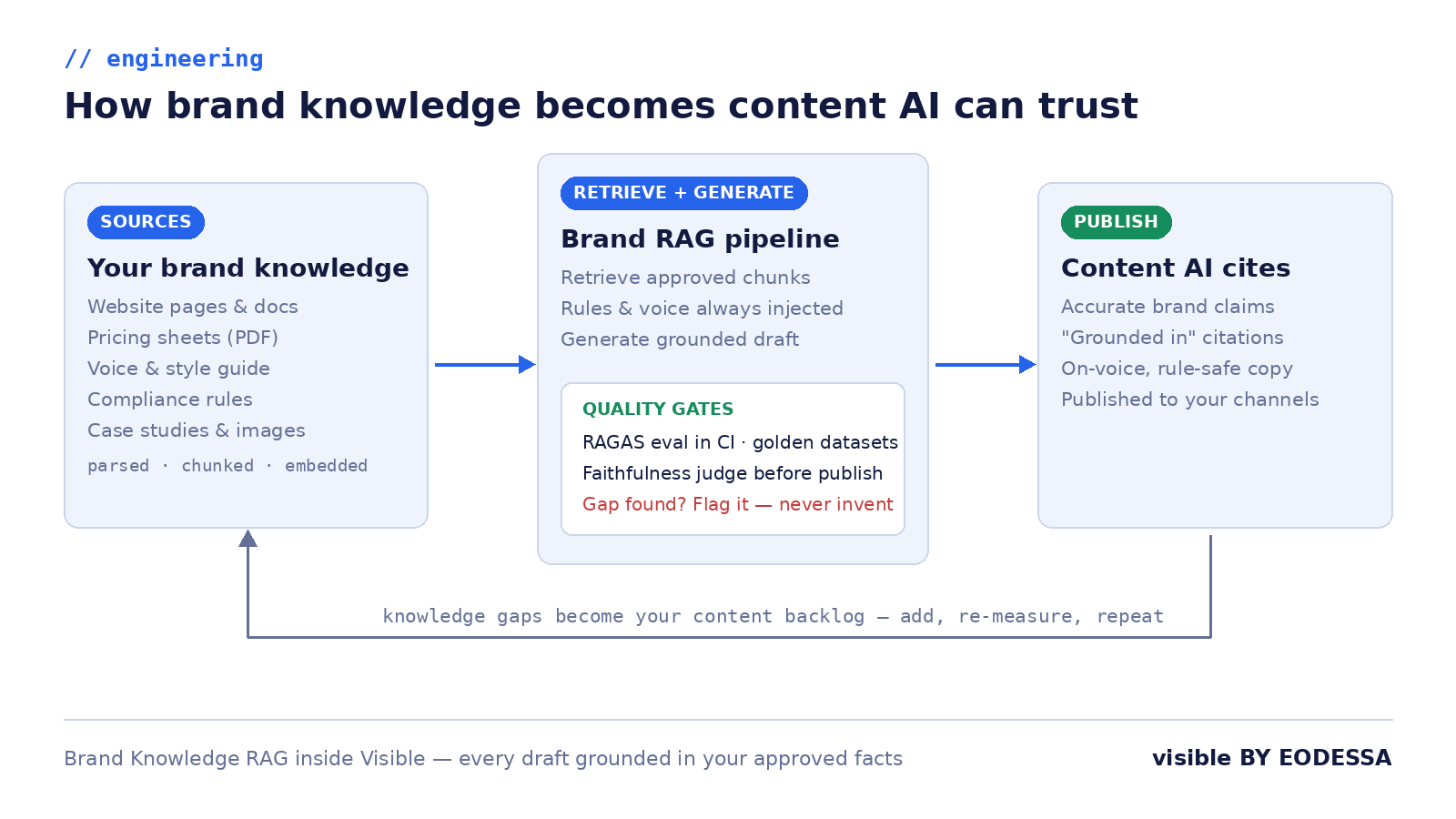
Before Visible writes a word for a brand, it studies the brand. Each brand on an account gets its own isolated knowledge base — website pages, product docs, pricing sheets, voice and style guides, compliance rules, case studies, even images, retrievable via caption and OCR. At generation time, the pipeline retrieves the relevant approved chunks, always injects the brand's rules and voice profile, and produces a draft with chunk-level "Grounded in" citations pointing back to the exact sources used.
Bound the claim: grounding doesn't make a model incapable of error. It changes where errors can come from, and — this is the part that matters — makes them detectable. Everything below is about that detection.
You can't fix what you measure in aggregate
A single "quality score" for a RAG pipeline is almost useless, because it can't tell you where things broke. Was the right chunk never retrieved? Retrieved but drowned out? Present in the prompt but ignored by the model? We measure at two levels, always:
- Component-level — retrieval gets precision@K, recall, MRR, and NDCG against a known-good dataset; generation gets faithfulness, answer relevance, and completeness. When quality drops, these say which pipeline stage to open up.
- End-to-end — answer correctness, hallucination rate, citation accuracy, and the two numbers that matter most to a marketer: draft acceptance rate and edit distance before publish. A pipeline where every component scores well but marketers rewrite every draft is still a failing pipeline.
RAGAS in CI, golden datasets per brand
We run RAGAS — the open-source RAG evaluation framework — as part of continuous integration, not as a quarterly review. Every pull request touching the retrieval pipeline runs the eval suite. Every time a brand's knowledge base changes, an incremental eval runs for that brand.
The fuel is a golden dataset per brand: twenty-plus real content briefs, each paired with the knowledge chunks that should ground it and the claims the output must support — plus traps. Briefs about knowledge that doesn't exist. Briefs that contradict brand rules. Facts that live only inside images.
The rule is simple: if a change drops a brand's golden-set precision or faithfulness below its recorded baseline, CI fails. Retrieval regressions get caught in code review, not in a client's published article.
Faithfulness is a gate, not a dashboard
Measuring hallucination after publishing is an autopsy. We wanted a checkpoint. After generation, an LLM-as-judge checks every factual claim in a draft against the chunks that were actually retrieved — supported, unsupported, or partial. For high-stakes brands this is a hard gate: content cannot move to approval until it passes, and unsupported sentences are highlighted directly in the review screen.
Is every claim supported?
Each factual claim is checked against the retrieved context. A draft with an unsupported claim is flagged before a human ever approves it.
Does that chunk support that sentence?
A draft can be faithful but mis-cited. Each claim–citation pair is scored separately — the check that keeps "Grounded in: Pricing page" honest.
One system-prompt line turned out to matter as much as any metric: instructing the model to synthesize rather than copy. Good retrieval plus a lazy generator produces plagiarized-sounding blocks of your own source documents — technically faithful, practically useless.
Knowledge gaps are a feature
The most counterintuitive decision: when the system can't answer, we made that a product surface instead of a failure state. If retrieval comes back weak for part of a brief — say, an article about enterprise SLAs when the knowledge base contains nothing about SLAs — two things happen:
- The draft says so. "I don't have information about your enterprise SLA" — with a one-click path to add that knowledge. It never fills the void with plausible fiction.
- The gap is logged. What was asked, how weak retrieval was, and how many times it has recurred — "asked fourteen times, still nothing" is visible, not buried.
That gap log turned out to be one of the most valuable datasets the system produces. It's a map of the questions your content should answer but can't — which is, almost by definition, your content-strategy backlog. Retrieval-failure data tells you exactly where the gaps are. We just decided to show it to you.
Key takeaway
RAG's failure modes are silent by default: wrong context looks right, hallucinations sound confident, stale facts blend smoothly with fresh ones. The answer isn't a better model — it's instrumentation. Measure each stage, freeze baselines per brand, gate the risky transition (publish), and turn "the system doesn't know" into something visible instead of something invented.
Frequently asked questions
What is Brand Knowledge RAG in Visible?
A retrieval-augmented generation layer that grounds every AI-generated article, post, and description in a brand's approved knowledge base — facts, products, voice, style, and compliance rules. Every draft carries chunk-level "Grounded in" citations back to its sources.
What is RAGAS and how does Visible use it?
RAGAS is an open-source framework for evaluating RAG pipelines. Visible runs its metrics — faithfulness, answer relevance, completeness, plus retrieval precision and recall — in CI against a per-brand golden dataset. Scores below the recorded baseline fail the build.
What is a faithfulness gate?
An LLM-as-judge check of every factual claim against the actually-retrieved context, run before content can be approved. For high-stakes brands it hard-blocks publishing, with unsupported sentences highlighted in the review screen.
What happens when the knowledge base can't answer part of a brief?
The draft flags the missing knowledge instead of inventing it, and a gap record is logged and counted. The gap report doubles as a content-strategy backlog.
What is a golden dataset?
A per-brand set of 20+ real briefs paired with expected grounding chunks and required claims — plus traps for gaps, rule conflicts, and image-only facts. It's the frozen regression baseline for retrieval and generation quality.
Content that AI systems can trust starts with knowledge they can check
See how Visible grounds every draft in your brand's approved facts — free forever, no card, no sales call.
Check your visibility — free →