Introducing Content Agent: Visible Doesn't Just Show You Where AI Ignores You Anymore — It Fixes It
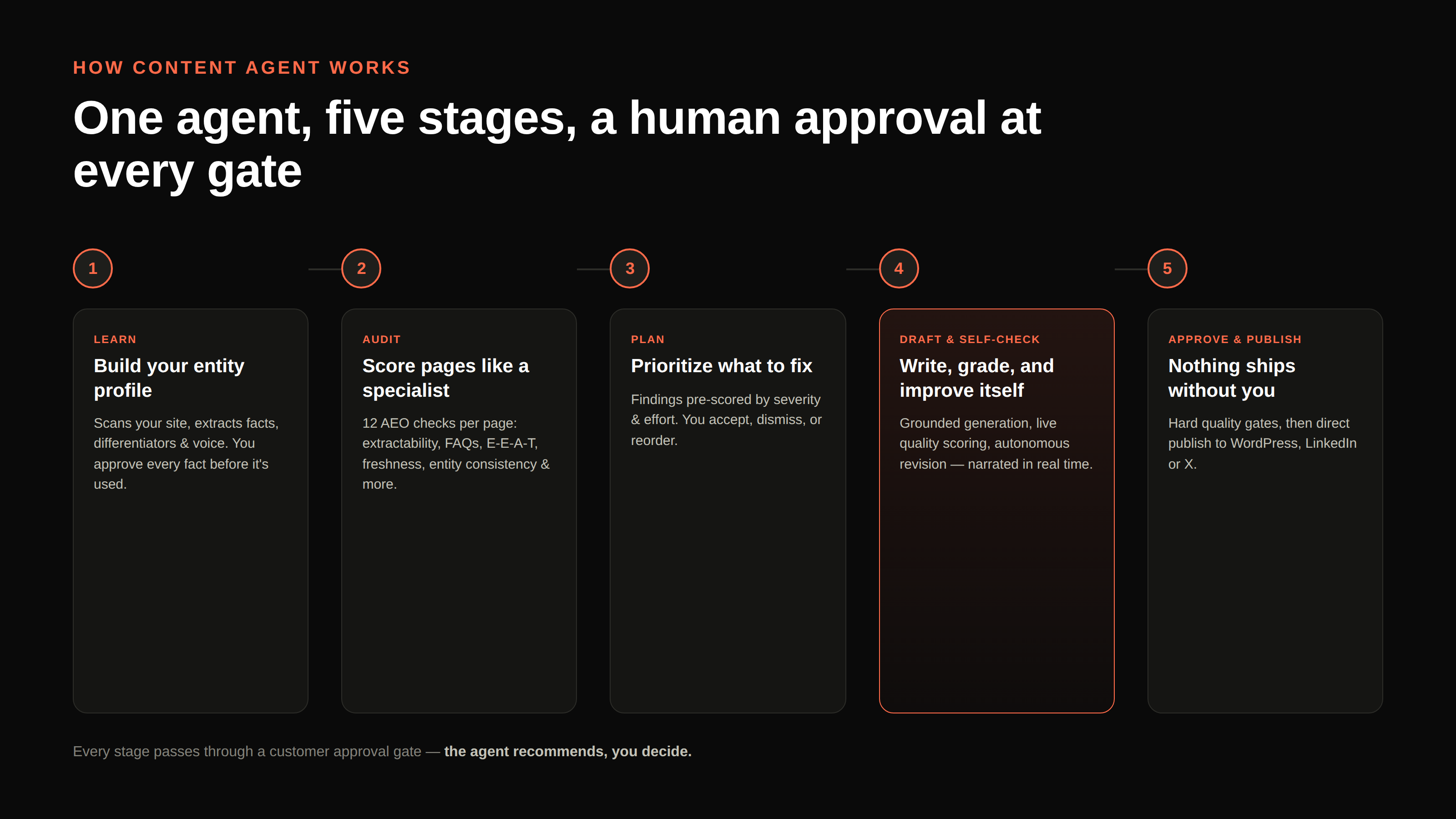
Content Agent is a self-service AI agent inside Visible by eOdessa that takes you from "AI engines barely mention my brand" to "here is answer-ready, fully cited content, checked and safe to publish" — in one guided pipeline. It audits your pages the way an AEO specialist would, prioritizes what to fix first, drafts the content that closes each gap, grades its own work against measurable quality scores, and improves the draft on its own before you ever see it. You stay in control of every word: nothing is published anywhere without your explicit approval.
That first paragraph is written the way answer engines like to read — the complete answer up front, no warm-up. Content Agent writes your content the same way. Here's the full story.
The problem: every AI visibility tool stops at the bad news
Businesses are scrambling to understand how they appear in ChatGPT, Claude, Gemini, and Perplexity. Tools that track AI search visibility — ours included, until today — have all had the same limitation: they tell you where you are invisible, and then hand you a report.
You learn that competitors get cited for your best topics and you don't. You learn that your pricing page never actually states who you are until paragraph six, so AI engines extract almost nothing from it. Then the tool's job is done and yours begins: figure out what "answer-ready content" even means, write it, hope you got it right, wait weeks to see if anything changed.
Agencies solve this with human strategy and copy teams executing a full AEO workflow — entity profile, content audit, prioritized plan, rewritten pages. That expertise has never been available in self-service form. A form that calls an LLM once doesn't count: generic AI content is precisely what answer engines are learning to ignore, and fabricated claims are worse than invisibility. Early AEO, like early SEO, briefly rewarded making things up — and punishes it permanently once cross-checking catches up with you.
Content Agent closes the loop properly. It is not a template wizard and not a one-shot generator. It is an agent driven by goals, constrained by guardrails, and governed by policies — it reasons about your site, your entity profile, and your brand rules, and it is architecturally incapable of publishing an unsupported claim.
What Content Agent actually does
One agent moves through five stages, with you approving the output of each.
Stage 0 — It learns who you are
Point Content Agent at your website. It scans your pages and extracts the raw material of your entity profile: what you do, what you should be known for, your differentiators, your location, your voice. You review every extracted fact in your Brand Knowledge profile, edit or remove anything, and approve it.
This step matters more than it looks. AEO is entity engineering: AI needs to reconcile who you are as an entity, and if a coherent, verifiable story doesn't exist, the models make one up — and it may not be a story you love. Your approved profile becomes the single source of truth for everything the agent writes. Content Agent never drafts a word until your profile is approved, and it never grounds content in anything you haven't confirmed.
Stage 1 — It audits your pages like an AEO specialist
Run an instant audit on any single page — the landing page you just shipped, the product page that underperforms — or feed the agent findings from a full-site Deep Scan. Every page is evaluated across twelve analysis dimensions, including:
- Extractability — can an AI engine actually lift answers from this page's structure? Short paragraphs, lists, tables, answer-first section leads.
- FAQ quality — are the questions your buyers ask answered directly, on the pages where they'd look?
- E-E-A-T signals — does the page state your expertise and authority explicitly, or expect AI to infer it? (It won't.)
- Freshness — stale dates and aging content that answer engines discount.
- Entity consistency — is your brand named the same way everywhere, or are "Acme Inc.", "Acme", and "Acme, LLC" three different entities to a machine?
- Content gaps — topics you track where you have no page at all to be cited for.
- Plus schema coverage, title/meta compliance, AI-crawler access, duplicate content, and site-architecture checks.
Findings come back in plain language — "This page has no FAQ section; competitors answer this question directly and you don't" — not as a spreadsheet of scores you have to interpret.
Stage 2 — It builds a prioritized plan you control
Every finding arrives pre-scored on two axes: severity (critical → low) and effort (quick fix → major). You accept the findings worth acting on, dismiss the rest, and reorder the plan however you like. Quick wins surface first. Nothing enters the drafting stage without your accept.
Stage 3 — It drafts, grades its own work, and improves it before you see it
This is the heart of the feature, and it's what separates an agent from a text generator.
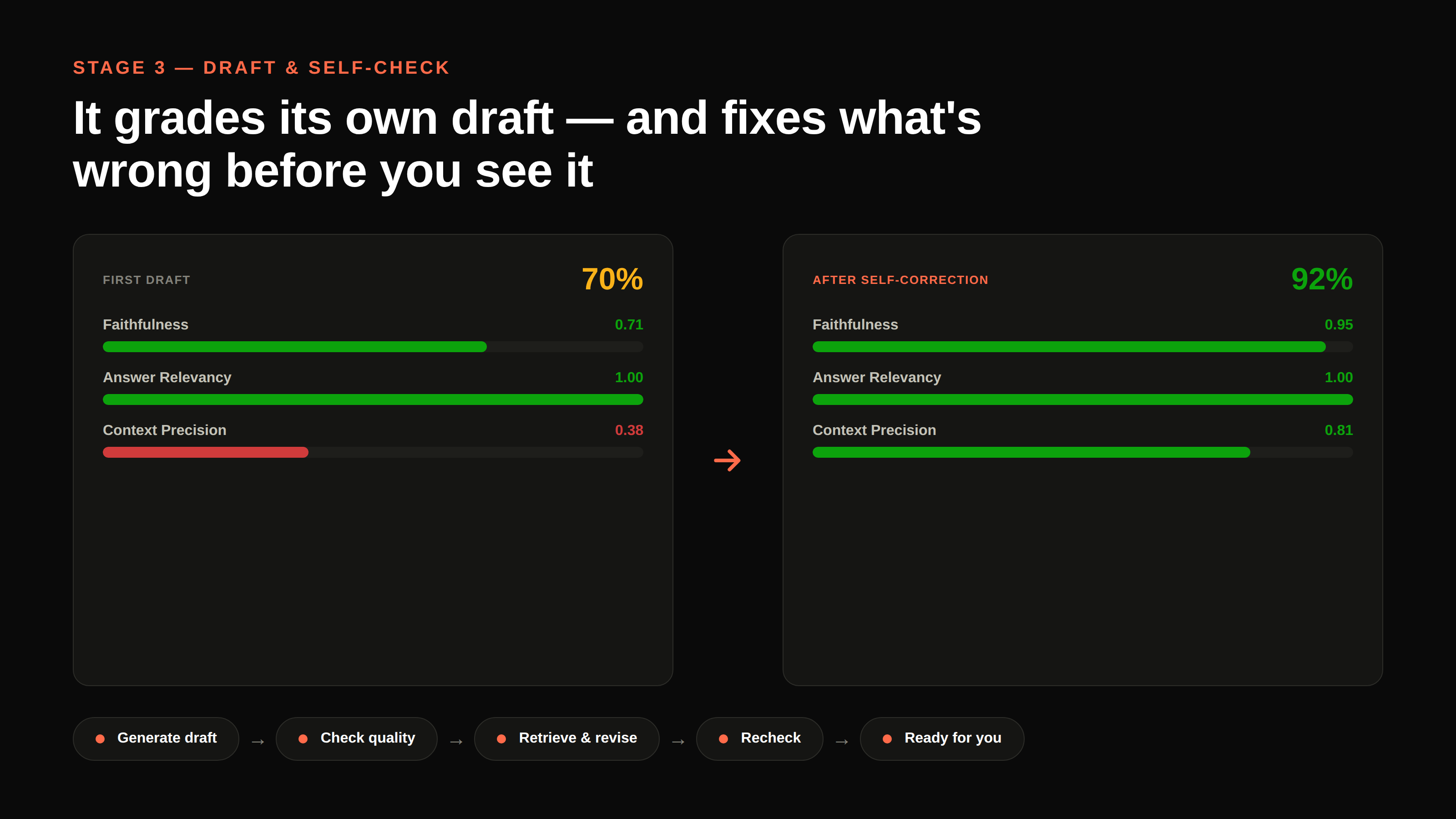
Click "Draft" on an accepted finding and Content Agent opens a live, two-panel workspace: your draft in a full editor on one side, the agent's working conversation on the other. The agent generates the draft grounded in your approved Brand Knowledge and the audited page — then immediately runs a Content Quality check on itself and shows you the report as a message:
Content Quality — Faithfulness: 0.71 · Answer Relevancy: 1.00 · Context Precision: 0.38 · Overall: 70%
And then — without being asked — it works the problem. Context precision low? It retrieves more from your Brand Knowledge and revises. An unsupported claim dragging faithfulness down? It removes or rewrites it. Every action is narrated in the chat as it happens: "Context precision is low — pulling more from your Brand Knowledge… Revised. Rechecking." You watch the draft improve in the editor in real time, and you can jump in and edit or redirect the agent at any moment — it's a two-way conversation, not a progress bar.
When the agent genuinely can't resolve something itself, it stops and asks you:
"I can't verify 'trusted by over 500 companies' against anything in your Brand Knowledge or this page. Do you want me to remove it — or is it accurate, and I should add it as a confirmed fact for next time?"
That question embodies the one rule we consider non-negotiable: the agent never fixes a faithfulness problem by rewording an unverified claim to sound more confident. It removes the claim, weakens it to what the evidence supports, or asks you. An AI that "improves" its quality score by better disguising a fabrication would be worse than one that never tried — so ours is built to be incapable of it.
Stage 4 — You review, approve, and publish — directly
Approved drafts publish straight to WordPress, LinkedIn, and X from inside Visible, or export as clean copy for anything else. The approve button is a real gate, not a formality — more on that below.
The guardrails: why you can trust what it writes
Giving an AI agent freedom to reason requires a protection system that cannot be talked out of doing its job. Content Agent runs a four-layer defense, and each layer covers the others' failure modes:
- Grounding. The agent writes only from your confirmed entity profile, your crawled pages, and our AEO execution standards — never from the model's open-ended "knowledge" about your business.
- Rules and policies. Platform-wide guardrails (no fabricated facts, no outcome guarantees, no regulated claims beyond your confirmed material) plus your own brand rules in plain language.
- AI supervisors. Separate model passes audit every draft in real time — a factuality supervisor tracing claims to sources, and a brand-guidelines supervisor checking voice and AEO compliance.
- Deterministic guards — code, not vibes. These run every time, no matter what.
Every claim, checked
Not optional, not configurable off. A draft with an unsupported claim cannot be approved.
A hard quality floor
Drafts scoring below the threshold on the RAGAS-style report simply cannot reach "approved."
- A rule-violation gate at publish time against your approved brand rules.
- A sensitive-data scanner on every draft and every revision — SSNs, card numbers, emails, phone numbers are flagged automatically. The agent doesn't decide to run this check; the code always does.
- Domain verification before crawling — the agent audits only domains you've proven you own.
- And the ultimate guard: publishing tools do not exist until you approve a specific draft. A pleasant conversation with the agent cannot skip the gates. If the agent says "looks great" and the gate still blocks, that's the system doing exactly its job.
Why this makes your content citable — the AEO payoff
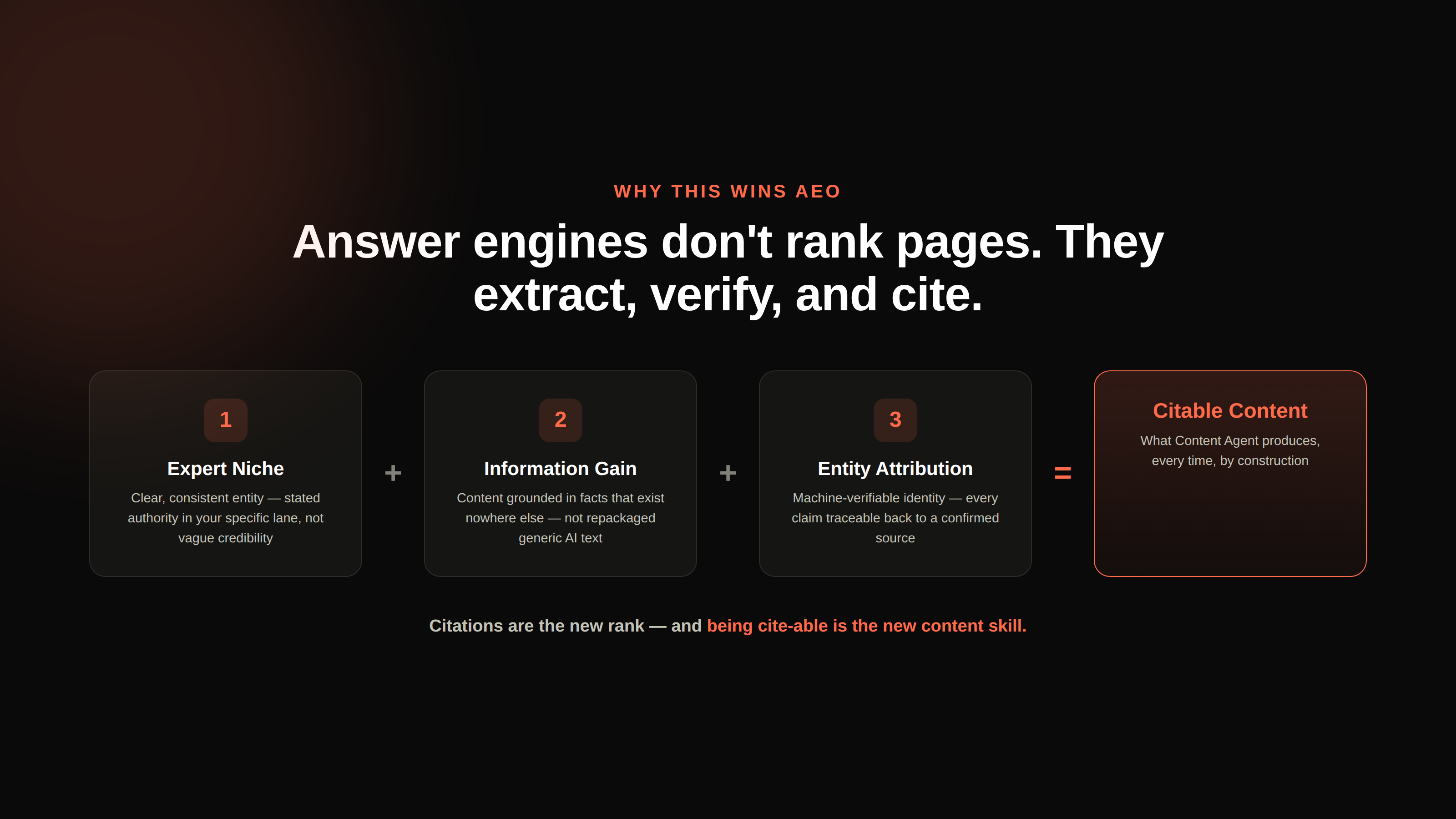
Answer engines don't rank pages; they extract, summarize, and cite. Citations are the new rank, and being cite-able is the new content skill. Content Agent is built end to end around what earns citations.
Every factual statement is traceable. Grounded generation plus the faithfulness and citation-accuracy gates mean each claim in a published draft traces back to material you confirmed. That's not just safety — it's strategy. Answer engines increasingly cross-check claims across sources; a trustable story with documented evidence is what survives. Fabricated testimonials and invented awards get you removed from the trusted-source pool, exactly like early SEO cheats got de-indexed.
Answer-first structure by default. Every draft follows the five answer-ready principles: structured formatting an AI can parse, clear and consistent entity references, explicitly stated authority, complete answers in the first sentences of every section, and extractable elements — lists, tables, FAQs — throughout. The agent audits your existing pages against these principles and writes new content that embodies them.
Entity engineering, systematized. From the approved profile through entity-consistency audits to consistent naming in every draft, the agent builds the coherent, machine-verifiable entity story that lets AI understand, verify, and connect your brand — expert niche + information gain + entity attribution.
Information gain, not word count. Because drafts are grounded in your confirmed facts, differentiators, and pages, they add what generic AI content can't: information that exists nowhere else. That's the "information gain" answer engines reward with citations.
The loop actually closes. Visible already tracks your AI search rankings, brand mentions, citations, and competitor share of voice. Now the same platform that shows you a citation gap drafts the content to fill it — and then measures whether your share of voice moved. Measure → fix → measure, in one product.
Who gets what
| Free | Basic — $69/mo | Pro — $249/mo | |
|---|---|---|---|
| Content audit | Teaser: top findings from 1 page | Full audits, up to 50 pages/scan, 2 scans/mo | Full audits, up to 250 pages/scan, 5 scans/mo |
| Agent drafts | Locked (upgrade to unlock) | 5 drafts/month | 50 drafts/month |
| Direct publishing | — | WordPress, LinkedIn, X | WordPress, LinkedIn, X |
| Custom brand policies | — | — | Included |
One detail worth calling out: revisions don't count against your draft quota. When the agent revises a draft ten times in a session to push the quality score up, that's still one draft. You're paying for finished, citable content — not for the agent's work ethic.
Key takeaway
Being visible in AI search is no longer about tricking a ranking algorithm. It's about being the most extractable, most verifiable, most citable answer to the questions your buyers ask. Until now, doing that well required an agency. Content Agent puts that entire discipline — audit methodology, prioritization logic, answer-ready writing standards, and the safety systems to trust the output — into a product you drive yourself. It finds where you're invisible. It writes what makes you citable. It proves every claim. And you approve every word.
Frequently asked questions
What is Content Agent in Visible by eOdessa?
A self-service AI agent that audits your pages the way an AEO specialist would, prioritizes what to fix, drafts answer-ready content grounded in your approved brand facts, grades its own draft against measurable quality scores, and revises it before you ever see it. You approve every stage, and nothing publishes without your explicit sign-off.
How does Content Agent avoid fabricating facts?
It writes only from your approved Brand Knowledge profile, your crawled pages, and platform AEO standards — never from a model's open-ended knowledge about your business. Every draft passes a faithfulness gate and a citation-accuracy gate before it can be approved; if a claim can't be traced to a confirmed source, the agent removes it, weakens it to what the evidence supports, or asks you directly.
What is the faithfulness gate and citation-accuracy gate?
The faithfulness gate checks every factual claim in a draft against your confirmed Brand Knowledge and blocks approval if a claim is unsupported. The citation-accuracy gate is a stricter check that a draft's RAGAS-style quality score clears a minimum threshold before it can reach "approved." Neither is optional or configurable off.
Can Content Agent publish content without my approval?
No. Publishing tools for a draft do not exist in the interface until you approve that specific draft — the agent can't talk its way around this because it isn't a conversational setting, it's what tools are available. Approved drafts then publish directly to WordPress, LinkedIn, and X, or export as copy for anywhere else.
How is Content Agent different from a generic AI writing tool?
A form that calls an LLM once produces generic content that answer engines are learning to ignore, with no way to verify what it claims. Content Agent is grounded in your specific entity profile and pages, runs deterministic guardrails on every draft, and grades and revises its own output against measurable quality scores before you ever see it — closer to an AEO specialist's workflow than a one-shot generator.
What does Content Agent cost?
Free includes a teaser audit of one page with drafting locked. Basic ($69/mo) includes full audits up to 50 pages per scan, 2 scans a month, and 5 agent drafts a month with direct publishing. Pro ($249/mo) raises that to 250 pages per scan, 5 scans a month, 50 drafts a month, and adds custom brand policies. Revisions don't count against your draft quota.
See where AI is ignoring you — and fix it
Start with a free audit of your most important page. No card, no sales call.
Start free →