How a Deep Scan Builds a Digital Twin of Your Site — and Tells You Exactly What to Fix for SEO & AEO
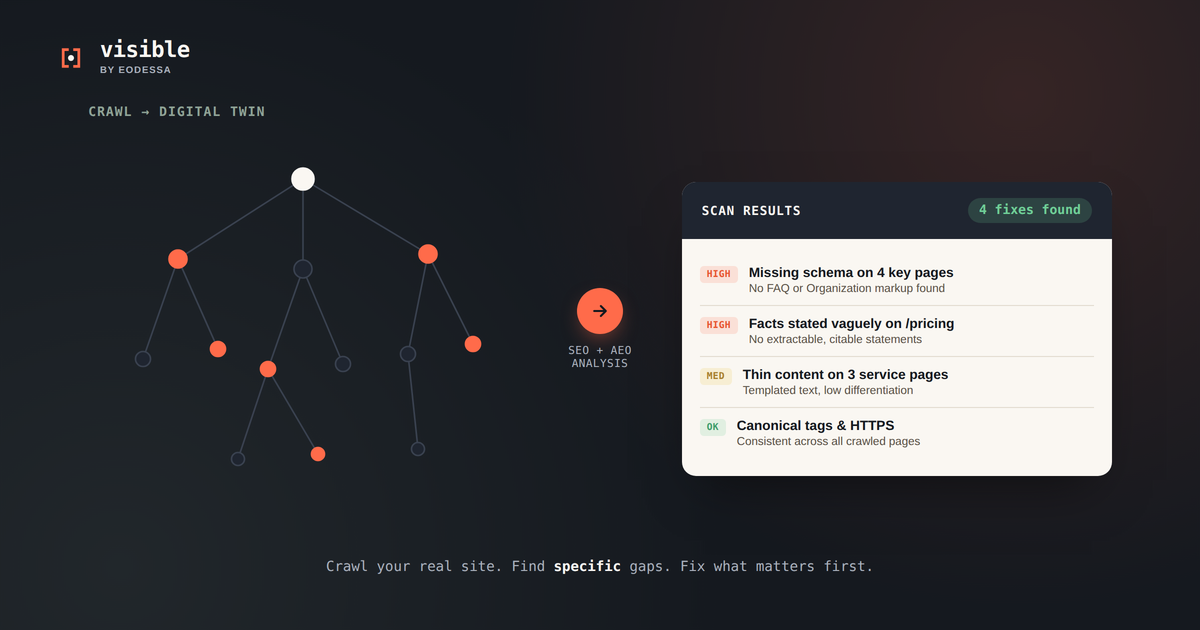
Most advice about improving your search and AI visibility is generic: add schema, write better content, get more links. A deep scan replaces that guesswork with evidence. It crawls your actual website to build a "digital twin" — a complete, analyzable model of every page — then evaluates that model for both SEO and AEO gaps, so you know precisely what to fix first on your site, not a hypothetical one.
What "deep scan" and "digital twin" actually mean
A deep scan crawls your website the way a real browser loads it — following internal links, rendering each page (including content that only appears after JavaScript runs), and capturing the structure, text, metadata, and links it finds. As it goes, it assembles those findings into a digital twin: a structured, queryable model of your real site.
That distinction matters. A digital twin isn't a screenshot or a single-page checker — it's a map of how your whole site is actually built and connected. Because the analysis runs against that model, every recommendation is grounded in what your site genuinely contains, rather than a generic template of "things sites should do."
Think of it like a building inspection versus a pamphlet on home maintenance. The pamphlet tells you what could be wrong with a house. The inspection walks your actual house and tells you that this beam is cracked and that outlet isn't grounded. A deep scan is the inspection.
Why guesswork is the real problem
The hardest part of improving SEO and AEO isn't knowing the tactics — it's knowing which tactics matter for your specific situation, and in what order. Generic advice produces long to-do lists where everything seems equally important, so businesses either freeze or spend effort on changes that don't move anything.
A deep scan cuts through that by finding the gaps that actually exist on your pages and ranking them by impact. Instead of "you should add structured data," you get "these four high-traffic pages have no schema, and your main service page is missing the FAQ markup that AI assistants pull from." That's a decision you can act on.
What a deep scan analyzes
A thorough scan covers two distinct layers, because ranking in Google and being cited by an AI assistant are no longer the same problem.
Can search engines find and rank you?
Crawlability and indexability, page titles and meta descriptions, heading structure, canonical and HTTPS consistency, internal linking, sitemap and robots coverage, thin or duplicated content, and page-level technical issues.
Can AI assistants extract and cite you?
Structured data and schema presence, clearly stated and extractable facts, definitional content, entity clarity (does the page make plainly clear who you are and what you do), and FAQ-style content AI engines tend to quote.
The reason both layers matter: the same page can rank perfectly well in Google and still be invisible to ChatGPT or Perplexity. Search engines rank a page; AI assistants extract facts from it and decide whether to cite it. A page can be optimized for the first and offer almost nothing the second can use — for example, a beautifully ranked page that states no concrete facts, carries no schema, and buries its key information in marketing prose.
The AEO half is where most sites are blind
Traditional audits have covered SEO for two decades. The newer, less-understood gap is AEO. When an AI assistant answers a question, it extracts specific, declarative facts and cites the pages that state them clearly. A deep scan looks for whether your site actually provides those:
- Are your key facts stated plainly? "Our passing score is 80%" is citable; a paragraph that dances around the number is not.
- Is there structured data? Schema markup (Organization, FAQ, Product, HowTo) helps AI engines understand and trust your content.
- Is your entity clear? Does each page make unambiguous who you are, what you offer, and where — the basics an AI needs to attribute a claim to you?
- Do you answer the questions people ask? FAQ-style, question-and-answer content is the format answer engines quote most readily.
How a scan becomes a decision
The output of a good deep scan isn't a data dump — it's a prioritized set of decisions. A typical flow:
- Crawl & model. The scan builds the digital twin of your site, page by page.
- Analyze both layers. Each page is checked against SEO and AEO criteria, and the findings are aggregated across the whole site.
- Prioritize by impact. Issues are ranked — a missing canonical on a key page outranks a cosmetic nit — so you start where the return is highest.
- Act with evidence. You make changes knowing why each one matters and which pages it affects, instead of applying generic fixes blindly.
Key takeaway
A deep scan turns "improve your SEO and AEO" — an overwhelming, generic instruction — into a short, ranked list of specific fixes on your actual pages. That's the difference between guessing and deciding.
Where a deep scan fits with ongoing visibility tracking
A deep scan and AI visibility tracking answer two different questions, and they work best together. The scan answers "what on my site is holding me back, and what should I fix?" — a point-in-time diagnosis. Visibility tracking answers "is it working?" — the ongoing measure of whether AI assistants are mentioning and citing you more over time.
Used as a loop, they compound: scan to find the gaps, fix the highest-impact ones, then watch your AI Search Visibility Score and citation rate to confirm the changes landed. If a fix doesn't move the numbers, you learn that too — and re-scan to find the next lever. This is how you replace a one-time audit that gathers dust with a feedback loop that actually improves visibility.
Frequently asked questions
What is a deep scan or digital twin of a website?
It's a crawl that loads your site like a browser — following links and rendering pages — to build a complete, analyzable model (a digital twin) of the real site. That model is then evaluated for SEO and AEO issues, so findings reflect what your site actually contains.
How is it different from a normal SEO audit?
A typical audit checks a sample of pages against a generic checklist. A deep scan models the whole site and analyzes both SEO factors (crawlability, metadata, structure) and AEO factors (schema, citable facts, entity clarity), then prioritizes the findings by impact.
What's the difference between the SEO and AEO parts?
SEO analysis is about whether search engines can crawl, index, and rank you. AEO analysis is about whether AI assistants can extract and cite you. A page can do well at one and poorly at the other, which is why a scan covers both.
How does it help me make better decisions?
It replaces generic advice with a prioritized list of gaps found on your real pages, so you spend effort where it will measurably improve visibility instead of on tactics that may not apply to you.
Run a deep scan of your own site
See your SEO and AEO gaps — and your AI Search Visibility Score across ChatGPT, Claude, Gemini, Perplexity, Google AI Overview, and Copilot. Free to start, no credit card.
Start your free scan →